How to Message a Recruiter on LinkedIn (So They Actually Reply)
Recruiters get dozens of messages a week and ignore most of them. Here's a simple three-line message that gets read, plus the small details — like saying you can start soon — that earn a reply.
Why Recruiters Ignore Most Messages
Recruiters aren't rude — they're buried. A single recruiter can get dozens of messages a week, most of which look the same: a long paragraph that starts with "I hope this message finds you well" and ends with "please let me know if there are any opportunities." There's no specific role, no proof of fit, and a big vague ask. It's easy to see why those get skipped.
The messages that get replies share three traits: they're short, they're specific, and they ask for something small. You don't need to be clever or impressive. You need to make it obvious, in about ten seconds of reading, who you are and what you're asking for.
Once you've found the right person to write to — the recruiter who actually hires for your function — the message itself is simple. Here's the structure.
First, Make Sure You're Writing the Right Person
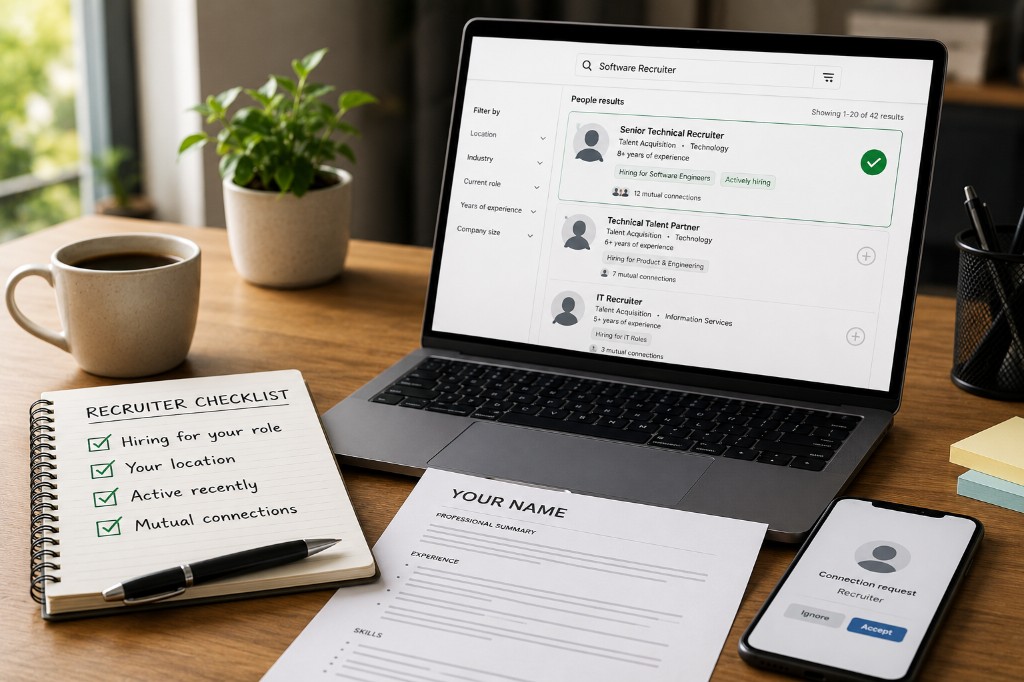
A perfect message to the wrong recruiter still goes nowhere. Before you write, confirm this person hires for your kind of role — their function, your level, and recent hiring activity. If you haven't done that step yet, start with our guide on finding the right recruiter on LinkedIn. It takes about ten minutes and saves you from sending great messages into a void.
Why the Recruiter Is Often Your Best First Contact
When you badly want a role, it's tempting to hunt down the hiring manager. But for most situations, the recruiter is the better first knock on the door. They know which roles are actually open, where each one is in the process, what the timeline looks like, and often the salary range. That's exactly the information you need early on.
Hiring managers are worth contacting too, but usually with a different, more specific angle — and often a little later. For a first message about an open role, the recruiter is the person whose job is literally to talk to candidates like you.
The 3-Line Message: Hook, Fit, Small Ask
Keep the whole thing to three or four sentences. Each line does one job:
- Line 1 — Hook (why you're writing): Name the specific role, or a real reason you picked them. "I saw you're hiring for a [role] at [company]" or "I noticed you recruit for [function] roles at [company]."
- Line 2 — Fit (one line of proof): Who you are, plus one concrete detail. "I'm a [your role] with [X] years in [area], and I recently [one specific, relevant result]." One line. No wall of text.
- Line 3 — Small ask (easy to say yes to): Ask for one low-effort thing. "Would you be open to a quick chat about it, or should I send my CV?" A yes/no question is easiest to answer.
That's it. Short enough to read on a phone between meetings, specific enough that the recruiter knows exactly what to do next.
The Details That Earn a Reply
Small, honest specifics are what separate a good message from a forgettable one:
- Name the exact role. "Are you still hiring?" makes the recruiter do the work of guessing. "The [specific role] posted last week" doesn't.
- Give one concrete proof point. A single real result beats five adjectives like "hardworking" or "results-driven."
- Say if you applied already. "I've applied through your careers page and wanted to introduce myself" is a natural, credible reason to reach out.
- Mention if you can start soon. If you're available immediately or have a short notice period, say so plainly: "I'm available to start right away." For many roles, especially urgent ones, a candidate who can join quickly is genuinely easier to move forward — it's a real advantage, not filler. (Only say it if it's true.)
When to Send a Connection Note vs. a Direct Message
How you reach them depends on how you're connected:
- Not connected, no premium: Send a connection request with a note (you have limited characters, so lead with the role and your fit). If they accept, you can send a full message for free.
- Already connected: Send a normal direct message using the 3-line structure.
- You have LinkedIn Premium: An InMail lands in their inbox without a connection, which can be worth it for a role you really want.
Whichever you use, the message itself stays short and specific. The channel changes; the structure doesn't.
Copy-and-Adapt Templates
Swap in your own details and cut anything that doesn't apply:
- Already applied: "Hi [Name] — I applied for the [role] at [company] last week and wanted to introduce myself directly. I'm a [your role] with experience in [area], including [one concrete result]. I can start on short notice. Would it help if I shared a quick summary of my fit, or is the role still in early screening?"
- No posting yet (interested in the company): "Hi [Name] — I've been following [company]'s work in [area] and I'm keen to join the [function] team. I'm a [your role] with [X] years in [area] and [one result]. Are you the right person to speak with about upcoming [function] roles?"
- Responding to their post: "Hi [Name] — I saw your post about the [role]. My background in [area], including [one result], lines up closely. Would you be open to a brief chat, or should I send my CV?"
Follow Up Once — the Right Way
If you don't hear back in about five business days, send one short follow-up. Don't just bump the old message — add a small new detail: a recent piece of relevant work, or a quick note that you can still start soon. Then stop. One thoughtful nudge is normal; a third and fourth message tends to leave the wrong impression. Recruiters manage huge message volumes, and plenty of good messages simply get buried for reasons that have nothing to do with you.
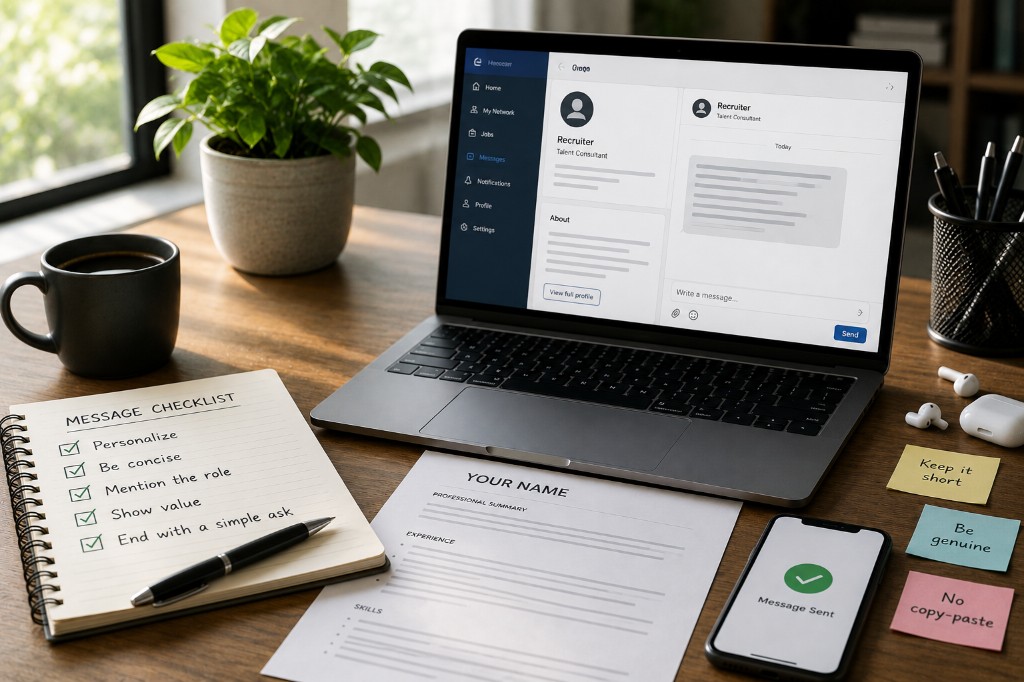
Checklist Before You Hit Send
- Is this recruiter the right one for your function and level?
- Is the message three or four sentences — readable on a phone?
- Did you name the specific role (or a real reason you picked them)?
- Is there one concrete proof point, not a list of adjectives?
- Did you make one small, clear ask?
- If you can start soon, did you say so (honestly)?
The Bottom Line
Getting a recruiter to reply isn't about a magic phrase — it's about respect for their time. Write to the right person, keep it to three lines (hook, fit, small ask), give one real proof point, and make the ask easy to say yes to. Mention you can start soon if it's true. Send one polite follow-up, then move on. Do that consistently and you'll get far more replies than the people sending long, generic notes to whoever they can find.