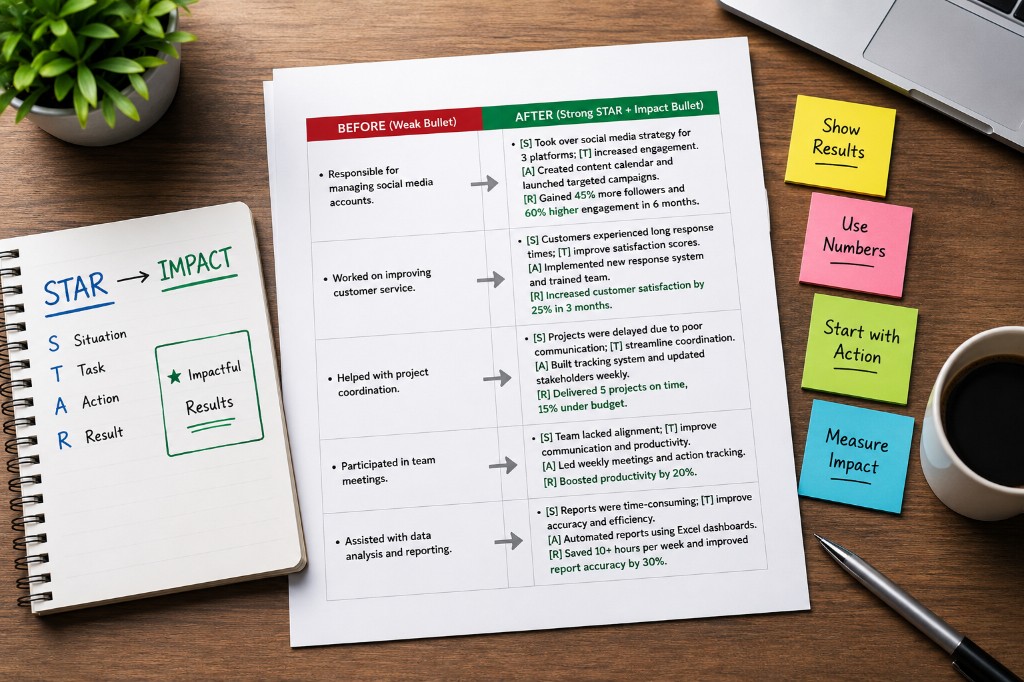
Stop Listing Job Duties: How to Write Resume Bullets That Prove Impact
Recruiters scan in seconds. Learn STAR thinking for your notes and XYZ bullets for the page — plus numbers and cross-team examples that work outside tech roles.
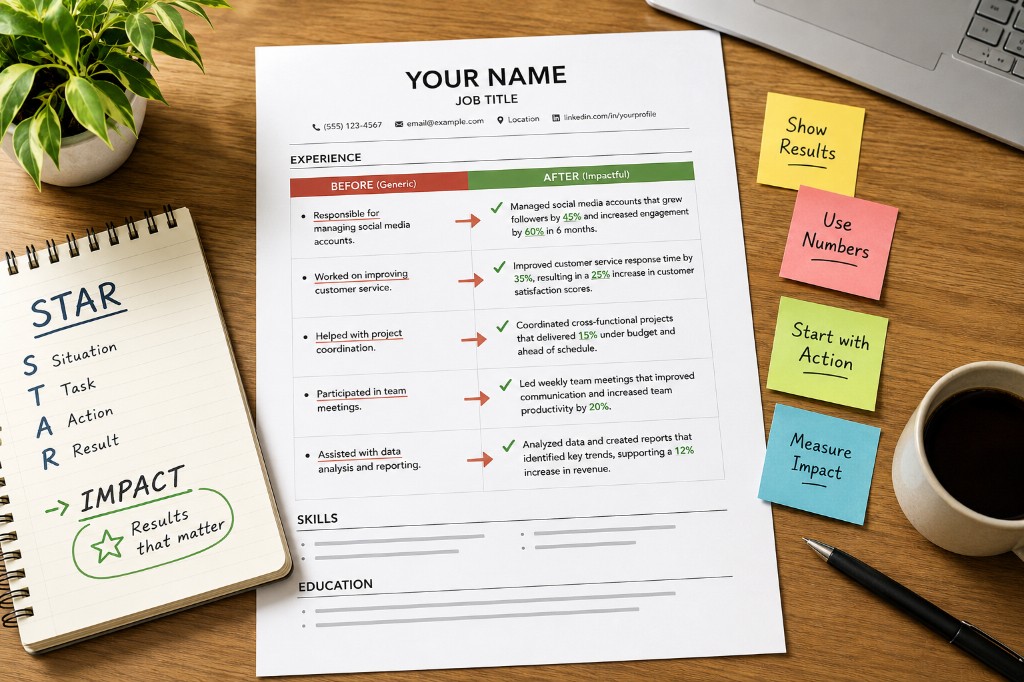
Why "Managed Social Media" Is Not a Resume Bullet
You have probably stared at a job posting, nodded along, and thought: I did most of this. Then you opened your resume and wrote something like "Managed client accounts" or "Supported cross-functional projects."
That is not lying. It is just incomplete.
Recruiters spend a few seconds on the first pass of your resume. In that window they are not reading carefully. They are scanning for proof — especially numbers — that you made something better, faster, cheaper, or easier for the people around you.
A duty tells them what seat you sat in. A strong bullet tells them what changed because you were there.
STAR Is How You Remember the Story
Before you touch your resume template, pull up a notes app and use STAR. It is a thinking framework, not a sentence you paste onto the page.
- Situation — What was messy, slow, or frustrating?
- Task — What were you responsible for improving?
- Action — What did you actually do?
- Result — What got better, and how do you know?
Here is a non-technical example in full STAR form:
Situation: New clients kept stalling between sales handoff and first invoice because nobody owned the in-between steps.
Task: You were asked to reduce onboarding confusion without adding headcount.
Action: You mapped the handoff, built a shared checklist with sales and operations, and trained both teams on it.
Result: Escalations dropped, and onboarding finished faster.
That is a complete story. It is also too long for a resume line. Which brings us to XYZ.
XYZ Is How You Write the Bullet
On the resume itself, compress STAR into the XYZ formula — a widely used structure for impact-driven bullets:
Accomplished [X] as measured by [Y], by doing [Z].
- X — The outcome you created
- Y — How it was measured: %, dollars, time, volume, score
- Z — How you did it: method, tools, collaboration
The STAR example above becomes one resume bullet: Reduced new-client onboarding escalations by 35% over two quarters by mapping sales-to-operations handoffs and rolling out a shared checklist used across 40+ accounts per month.
You do not need the words "Situation" or "Accomplished" on the page. You need all three ideas present: outcome, proof, method.
The sentence order can flex. Leading with the number is fine when the number is strong: Cut vendor onboarding time 40% and saved $75K annually by standardizing intake forms with finance and procurement.
Replace Duties With Numbers (Any Field, Not Just Tech)
Numbers are not only for sales quotas and technical roles. Almost every job touches something countable.
-
Customer support
- Cases closed per week, response time, satisfaction score
-
Retail / hospitality
- Audit scores, training completion, shift coverage
-
Marketing / comms
- Click-through, leads, event attendance
-
Operations / admin
- Processing time, error rate, vendors managed
-
People / training
- Hires onboarded, sessions delivered, retention
Weak → strong examples:
Before: Responsible for training new staff. After: Trained 6 new associates on POS and inventory counts, raising checkout accuracy audit scores from 82% to 94% in 90 days.
Before: Helped with email campaigns. After: Partnered with design and sales on 8 email campaigns, lifting click-through 22% and generating 250 qualified leads in one quarter.
Before: Improved the vendor process. After: Standardized vendor intake with finance and procurement, cutting onboarding time 40% and saving $75K annually.
Before: Ran community events. After: Coordinated 12 regional volunteer trainings (200+ attendees), reducing same-day setup time 30% through reusable supply kits.
No perfect number? Use defensible scope: team size, accounts per month, budget range, or "from days to hours." Do not invent figures you cannot explain in an interview.
Show Collaboration and Leadership Without Overclaiming
Recruiters also want to see how you work with others — but that does not mean listing every department you ever emailed.
Aim for 2–4 bullets per recent role that mix:
- Scope — volume, budget, geography, or ownership
- Cross-team work — name the functions (sales, finance, support), not a laundry list of tools
- Influence — led, facilitated, mentored, owned — only if true
Collaboration bullets that read human:
Facilitated weekly alignment between support and billing, cutting refund processing from 5 business days to 2 and reducing repeat contacts 18%.
Partnered with product, marketing, and finance to redesign renewal messaging, contributing to a 12-point lift in renewal survey scores over 6 months.
Mentored 3 junior coordinators through their first quarterly planning cycle; all three hit cross-team deadlines on shared deliverables.
If you coordinated a working group but did not manage headcount, say facilitated or "owned the workstream" — not "led the entire company."
Cut feature-only bullets. A line about implementing a new system module earns space only if you tie it to Y — time saved, errors cut, adoption, revenue, or satisfaction. Otherwise merge it into a broader outcome or delete it.
Quick Exercise Before You Edit
For your most recent job, write three STAR notes. Then rewrite each as one XYZ bullet.
Ask yourself:
- Can a stranger see what improved?
- Is there at least one number?
- Does it show how you worked with others when that mattered?
Summary checklist:
- Each recent role has at least one bullet with a measurable Y
- Bullets include outcome + proof + method (XYZ), even if word order varies
- At least one bullet names cross-team partners and a result
- Leadership language matches what you actually did
- No bullet is just a duty or tool name with no outcome
The Bottom Line
Think in STAR when you are remembering the work. Write in XYZ when you are fighting for six seconds of attention. Duties describe the job. Numbers describe you.
Companion piece: One Page Is Enough — what to keep on your resume and what to delete.