One Page Is Enough: What to Keep on Your Resume (And What to Delete)
One page is a signal, not a humility contest. Learn what belongs in the contact block, what recruiters still see that you should delete, and how to put your best proof above the fold.
The One-Page Rule Is Not About Being Humble
"Keep your resume to one page" sounds like advice for beginners. It is not.
One page is a signal: you know what matters for this role, you can prioritize, and you respect how little time a recruiter has. Most people through roughly ten years of experience should aim for one page. Two pages is reasonable for senior roles where every line carries scope — not for padding early jobs with old club memberships.
The goal is not to shrink your career. It is to put your strongest proof where eyes land first.
Top Half of Page One Is Prime Real Estate
Before anyone reads your oldest internship, they see the top third of page one. That zone should contain:
- Your current or most relevant title
- Your strongest quantified bullet
- At least one line showing scope or cross-team impact
Older roles get fewer lines. Recent work gets the ink.
Practical split:
-
Current / most relevant job
- 3–5 bullets
-
Previous 2–3 roles
- 2–3 bullets each
-
10+ years ago
- 1–2 bullets, or one merged line
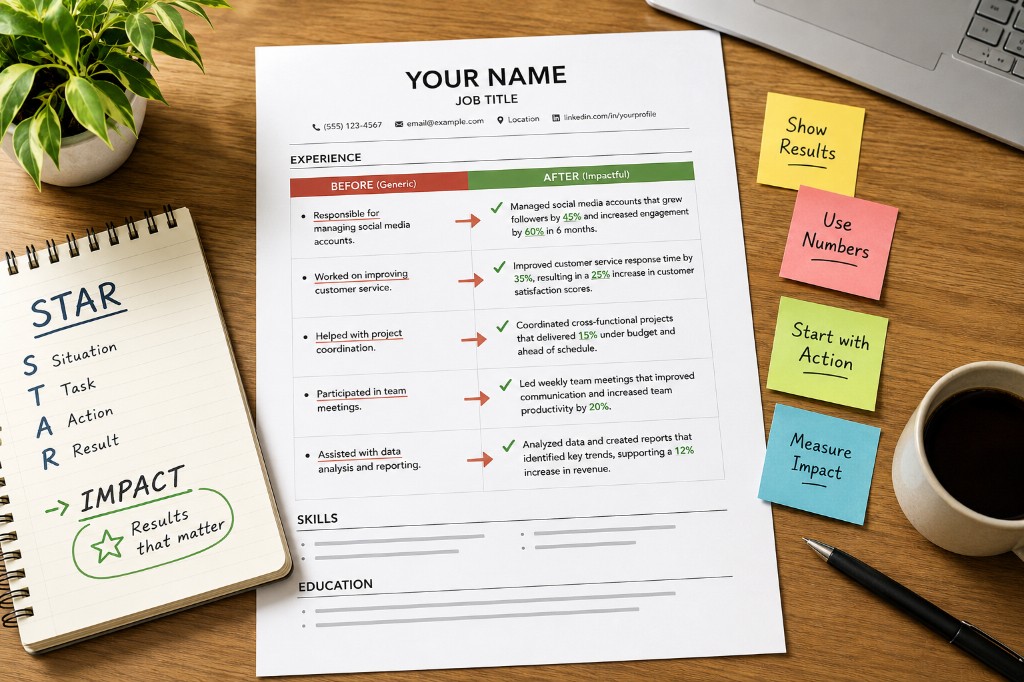
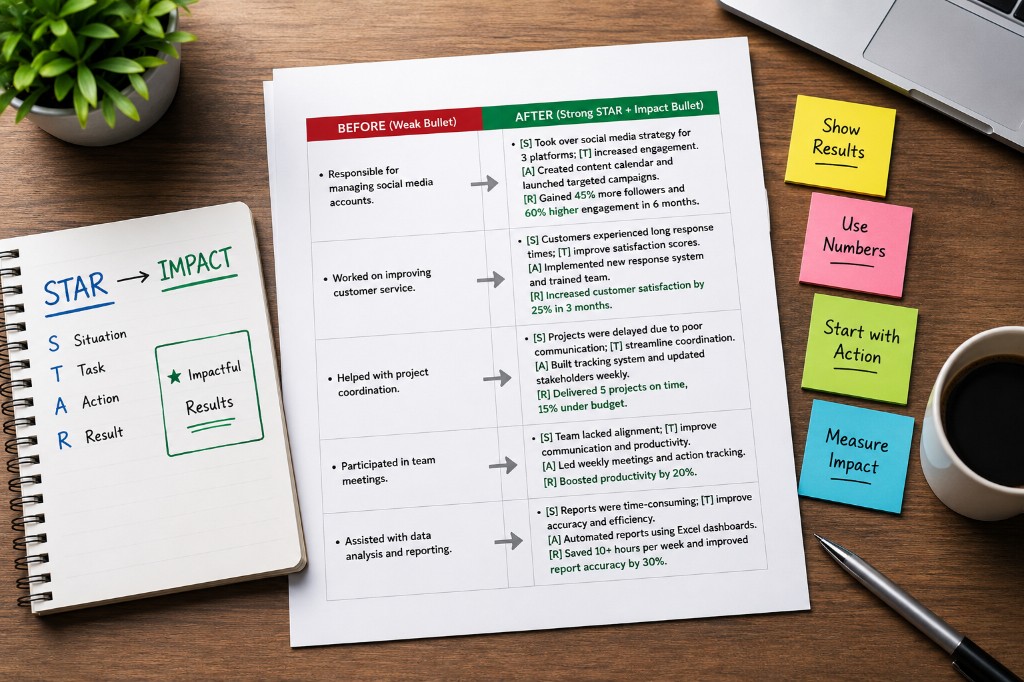
If two bullets say the same skill, merge them. If a bullet has no number and no clear outcome, cut it or rewrite it using STAR notes from the bullets article.
Your Contact Block Should Be Boring (In a Good Way)
Recruiters need to reach you. They do not need your life story in the header.
Keep it tight — one cluster:
Name · Phone · Professional email · Profile link · City, State
Optional: "Open to remote" if that is true.
Use a clean, professional email address you check daily. An outdated or personal-sounding address can make materials feel stale before anyone reads a single bullet.
Do not include:
- Full street address
- Photo
- Marital status, age, or full date of birth
Nobody is mailing you an offer letter. Full addresses add privacy risk and can introduce bias in hiring. Photos are standard in some countries; in many markets, recruiters treat them as unnecessary or risky on a resume.
Delete These — They Still Show Up Every Day
-
"Objective" ("Seeking a challenging role…")
- Your objective is the job you applied for. It wastes space. If you use a summary, make it 2–3 sentences of proof, not a wish list.
-
"References available upon request"
- Assumed. Keep references on a separate sheet for when they ask.
-
Unrelated hobbies
- Keep only if they directly support the role (e.g. public speaking for client-facing work).
-
Long unranked skills clouds
- Pick 8–12 skills that match the posting instead of every tool you touched once.
-
Every job since high school
- Collapse or drop when it pushes you to page two without adding relevance.
-
Dense paragraphs
- Bullets scan; paragraphs stall.
Keep: Education (trimmed), certifications that matter, licenses if required, and links that strengthen your case (portfolio, professional profile).
Formatting That Helps the Scan (Not the Design Portfolio)
Your resume is a PDF for skimming, not a creative layout exercise — unless you are applying for a design role.
- 10–11 pt body font, consistent throughout
- 0.5–0.75 inch margins
- Consistent dates: Jan 2022 – Present
- Same structure for every role: title, company, dates, bullets
Save creative layout for your personal website. Recruiters and applicant tracking systems both prefer predictable structure.
How the Two Pieces Fit Together
This article is about container and clutter. The companion piece — Stop Listing Job Duties — is about bullet content: STAR thinking, XYZ writing, numbers, collaboration.
You need both: a tight one-page document and bullets that prove impact. A clean one-pager full of "Responsible for…" still loses. A page of strong numbers buried on page two still loses.
Order of operations:
- Cut clutter and fit one page.
- Rewrite bullets with XYZ.
- Move your best bullet to the top half of page one.
Summary Checklist Before You Send
- One page (unless senior scope truly needs two)?
- Strongest bullet and clearest role fit in the top half of page one?
- No photo, no full street address, no generic objective?
- Contact line: phone, email, profile link, city/state only?
- 8–12 relevant skills, not a keyword cloud?
- Every remaining bullet has an outcome (see bullets article)?
- Saved as a clean PDF with a sensible file name (FirstName-LastName-Resume.pdf)?
The Bottom Line
A one-page resume is not a downgrade. It is an edit. Remove what recruiters ignore, put your best proof where eyes go first, and let the numbers on your bullets do the work once the page is clean.